Wherever people wait for attention, the same problem appears: somebody needs something and nobody knows. Calling out, waving, getting up, going to look. BusyDot® replaces all of that with a button and a light – and gives the team an overview of who is waiting and for how long.
No app for the guest
Anyone pressing the Dot needs no phone, no account and no instructions. One button is enough.
One overview for the team
A tablet or a computer shows every open call, sorted by waiting time. Whoever takes it taps once.
No IT project
No cable, no tradesperson, no systems integration. Stick the ring on, attach the Dot – and it runs, even without anyone in IT knowing about it.
The scenarios below are application pictures from development, not products you can order. Which one comes first is something we decide with our first partners.
Scenario 01
Offices, public authorities, law firms
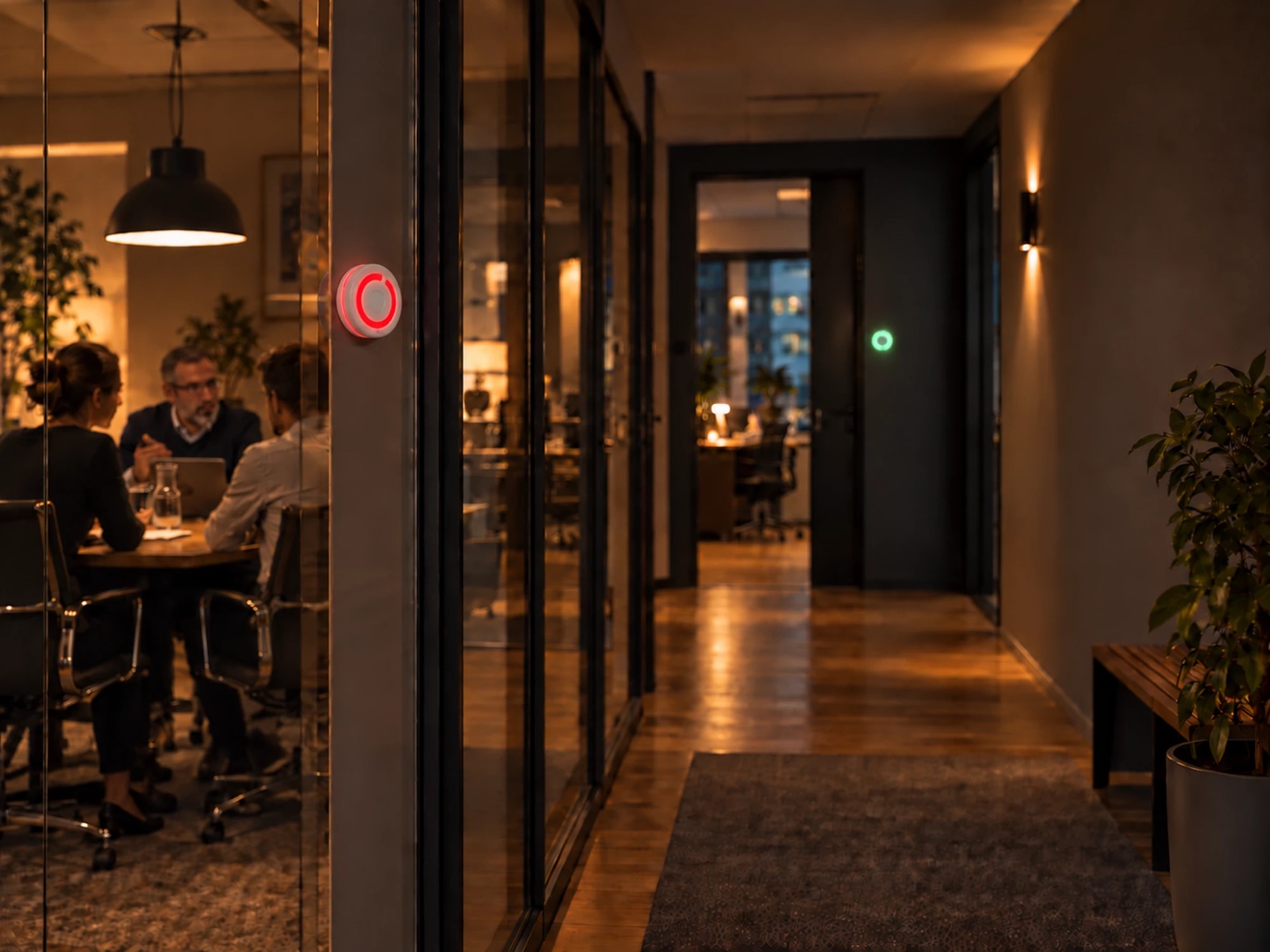
The biggest market is the most obvious one: anywhere with a lot of doors side by side. Meeting rooms and private offices share the same problem – whoever stands outside cannot tell what is going on inside. So they knock. Or wait. Or leave and come straight back.
Meeting rooms: the Dot sits outside on the glass wall or the door frame. Red means still running, amber means ending shortly, green means free. Set from the room calendar or by hand.
Private offices: the same Dot, a different meaning – here it shows the person rather than the room. On the Mac it switches by itself as soon as a call starts.
For the building: one overview shows which rooms are taken and which are free. Nobody has to walk the corridor looking for a free room.
Especially suited where confidentiality meets public traffic: public authorities with many private offices and consultation hours, law firms with client meetings, consulting and treatment rooms. From a ten-person business to a corporate site, the same principle scales – one Dot per door.
Rooms & offices Third floortoday
Meeting room Oldenburgbooked until 14:30
Meeting room Bremenends in 4 min.
Meeting room Hattenfree
Office 3.12 · Dr. Sanderclient meeting
Office 3.14 · Krögeravailable
A recreation. Rooms come from the calendar, offices from each person’s Mac.
Scenario 02
Medical practice
In the waiting room a name is called out. Anyone hard of hearing, not fluent in the language, or briefly out in the corridor misses it – and everyone else learns in passing who is next.
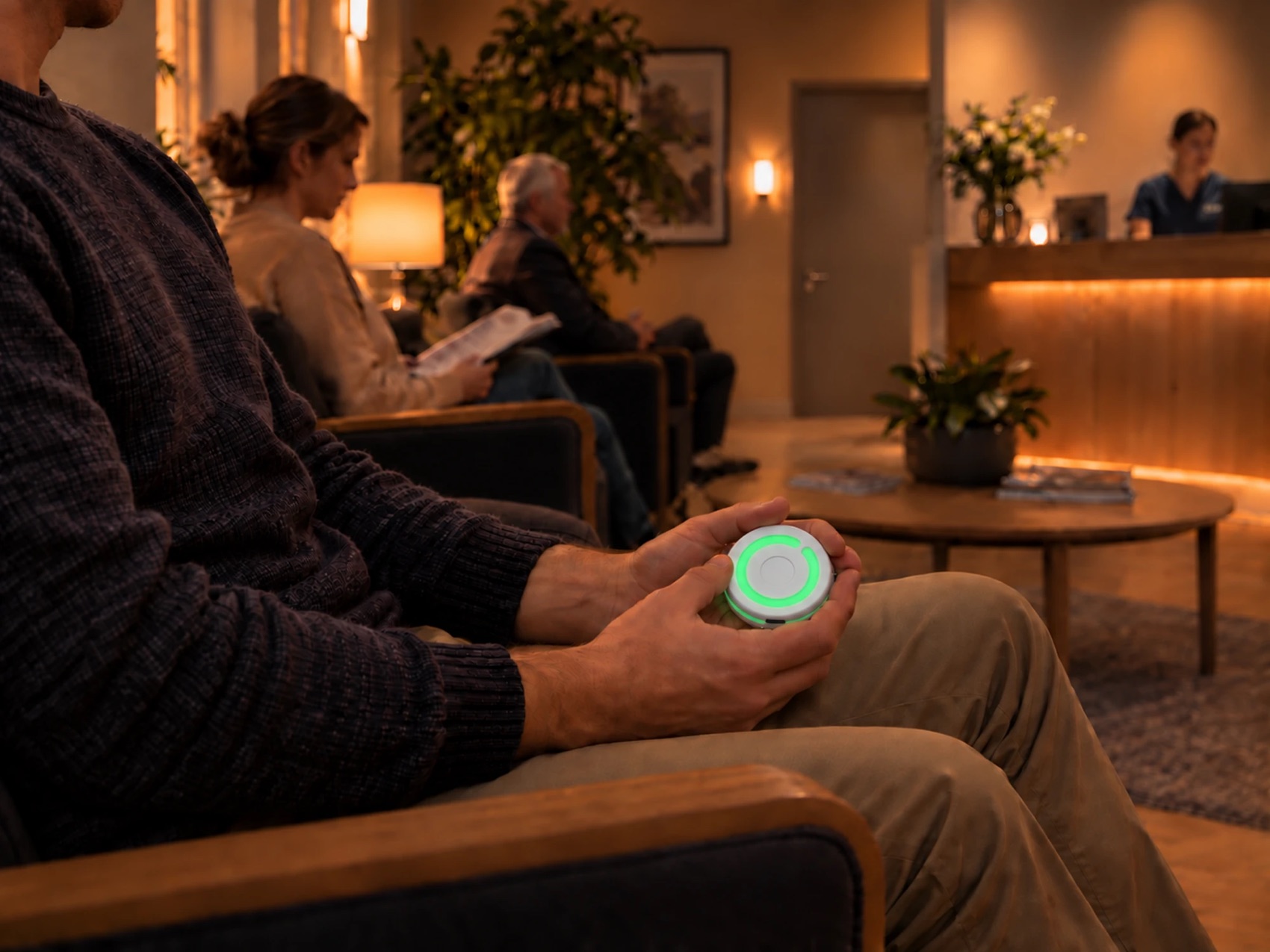
At check-in the waiting person is handed a Dot. No app, no account, no number to remember.
The practice calls from the tablet – the Dot in that person’s hand lights up and vibrates. Only that one.
No name is said out loud. Which happens to be the more data-frugal solution too.
Call-up Waiting room3 waiting
Dot 12waiting 18 min.
Dot 08waiting 9 min.
Dot 03waiting 4 min.
Call Dot 12
A recreation. The call reaches exactly one Dot.
Scenario 03
Care and clinics
Not every request is an emergency. Help getting to the bathroom, a glass of water, a question – nobody likes pressing the emergency call button for those, which is exactly why people wait until somebody happens to pass by.
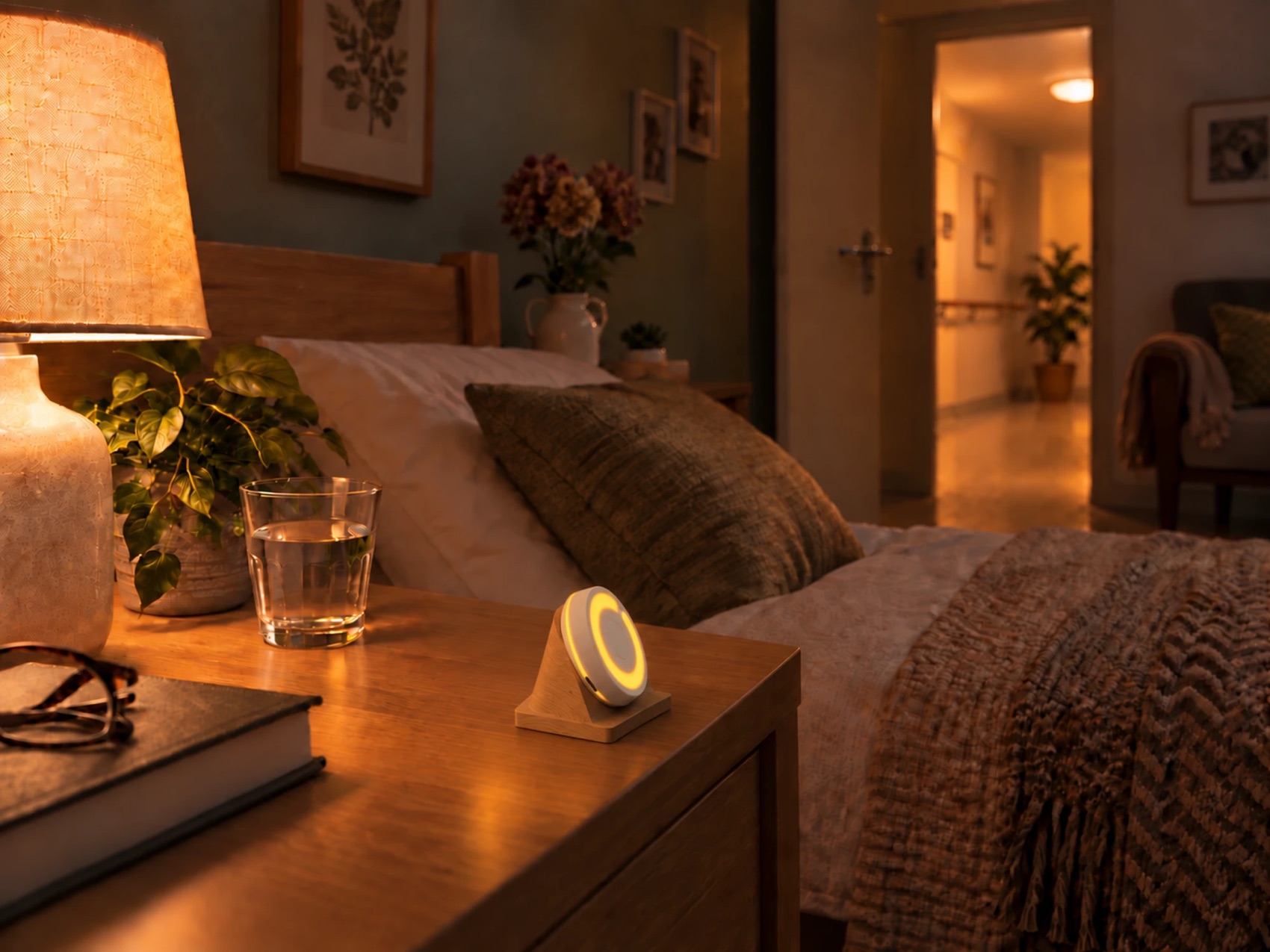
A Dot on the bedside table or the room door makes the difference between “urgent” and “whenever suits” visible.
The team sees at a glance which room is waiting and for how long – and who has already taken the call.
No duplicated trips: once someone takes a call, it disappears for everyone else.
Important: BusyDot® is not a replacement for a nurse call system and is not intended for medical emergencies. It complements one, covering the many small requests that today never get reported at all.
Assistance Ward A2 open
Room 12open · 3 min.
Room 08Lea is taking it
Room 05quiet
Take Room 12
A recreation. Not a replacement for a nurse call system.
Scenario 04
Restaurants and hotels
The guest looks for eye contact, the staff are in the kitchen. Two minutes later the guest waves, three minutes later they stand up. None of it was necessary – the information “table 5 wants something” simply never reached the team.
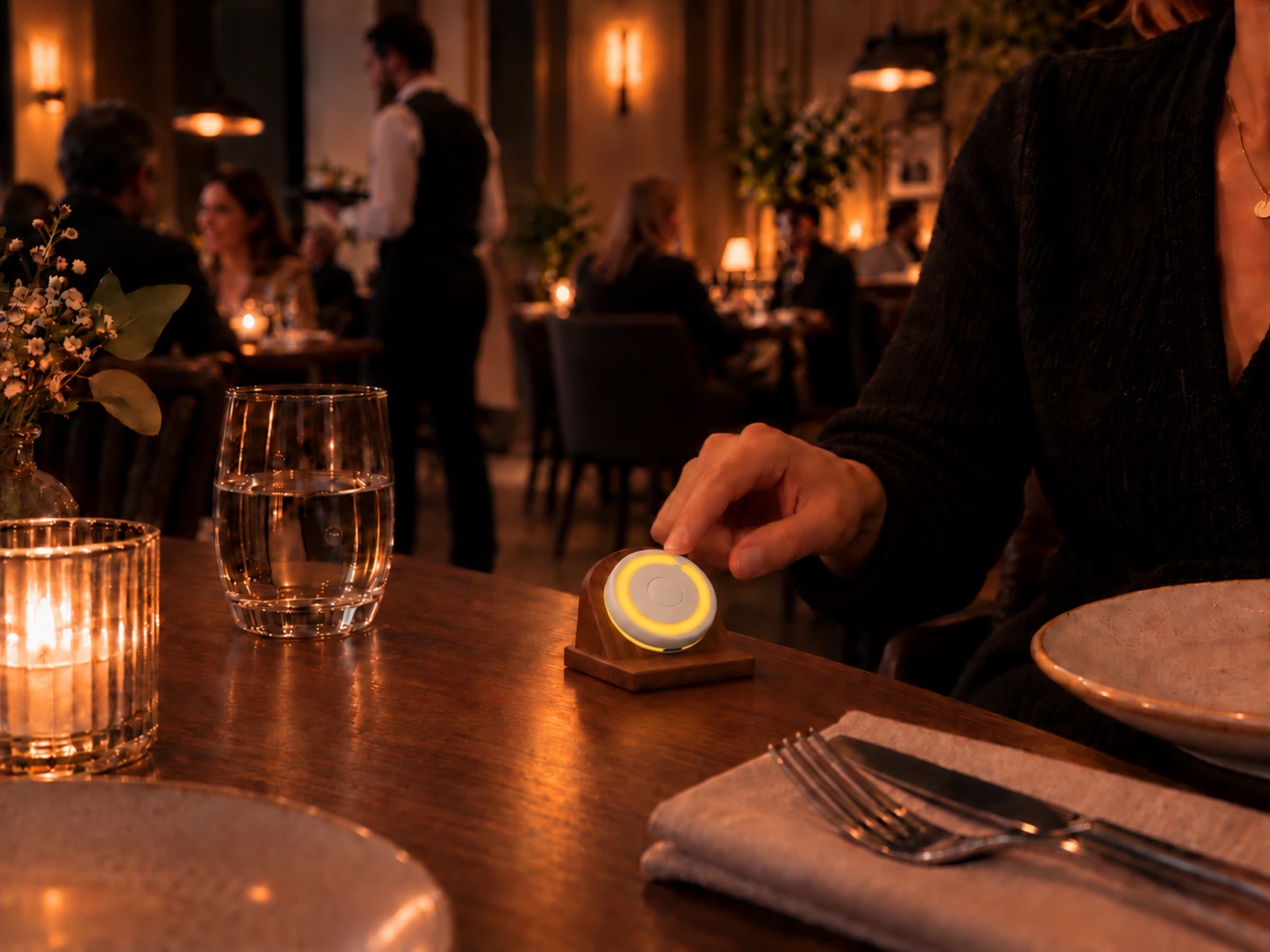
One Dot per table. One press is enough, and the light confirms to the guest that the call has arrived.
A tablet at the bar shows the floor plan: which table is calling, since when, and who is taking it.
Waiting time becomes measurable – and for the first time, manageable.
Service Dining room1 open call
123456
Table 5waiting 0:45
Table 2Anna is taking it
A recreation. One Dot per table, one tablet for the team.
Scenario 05
Schools
The same children raise their hands every lesson, others never do. No teacher can keep count on the side of who has already had a turn – and the quiet ones slip through for exactly that reason.
One Dot per seat. Whoever wants a turn presses – no need to keep an arm in the air.
The teacher sees the order in which hands went up, not just the fastest ones.
Requests and actual turns are counted separately. At the end of the lesson it shows who never got a turn.
Class 3a Mathematics3 hands up
MilaNoahLeaBenEllaTom
Mila6 requests · 2 turns
A recreation. Requests and turns are counted separately.
In practice
Stuck on, not plugged in.
The usual route for something like this is a tender, cabling, an interface, training – and then it sits in the project plan for two years. BusyDot® takes the short route: you can start in one corridor tomorrow and decide next month whether it becomes the whole building.
Mounted in minutes
A self-adhesive metal ring, the Dot held magnetically in front of it – on glass too. No drilling, no wiring, no tradesperson. It leaves no marks when it comes off, rented premises included.
No systems integration
No server, no interface project, no interference with existing systems. The overview runs on a tablet or computer that is already there. A pilot with five Dots needs no sign-off from IT.
Software when you need it
We build on top of the button: overviews per area, roles for the team, waiting-time analysis, later connections to room calendars or point-of-sale systems. You start small and grow into it – not the other way round.
Data-frugal
A Dot knows a number, not a name. No microphone, no camera, no location, no obligatory cloud. Who holds which Dot is known only to the organisation.
Let us talk
Which scenario is yours?
BusyDot® is in development. Which of these applications ships first will be decided by our first partners – organisations willing to run a pilot, and investors backing the early phase.
Scenario 01
Offices, public authorities, law firms
Meeting rooms and private offices: the Dot on the glass wall or door frame says what is going on inside – before anyone touches the handle.
Pilot project
Practice, care home, hospitality, school or office: tell us which scenario fits you and how many places it covers. We will come back with a concrete proposal. info@busydot.de
Investor Relations
We are looking for partners who see more than a status light for the home office: a signalling layer for places where people wait for attention. info@busydot.de
Florian Hausjell & Felix Rüger, Anschrift wie oben.
Marke
BusyDot® ist eine beim DPMA eingetragene Marke (Registernummer 302025201786) und daher geschützt.
Haftung für Inhalte
Die Inhalte dieser Website wurden mit größter Sorgfalt erstellt. Für Richtigkeit, Vollständigkeit und Aktualität übernehmen wir jedoch keine Gewähr.
Haftung für Links
Diese Website enthält Links zu externen Websites Dritter, auf deren Inhalte wir keinen Einfluss haben. Für diese fremden Inhalte ist stets der jeweilige Anbieter verantwortlich.
Urheberrecht
Alle Inhalte, Bilder und Designs unterliegen dem deutschen Urheberrecht. Jede Verwertung außerhalb der Grenzen des Urheberrechts bedarf der schriftlichen Zustimmung der Urheber.
Rechtliches
Datenschutz
1. Verantwortlicher
BusyDot GmbH, Pappelallee 3, 26209 Hatten, vertreten durch die Geschäftsführer Florian Hausjell und Felix Rüger. E-Mail: info@busydot.de
2. Allgemeines
Wir verarbeiten personenbezogene Daten ausschließlich nach DSGVO und BDSG. Diese Erklärung informiert über Art, Umfang und Zweck der Verarbeitung auf www.busydot.de.
3. Hosting
Diese Website wird bei der STRATO AG, Otto-Ostrowski-Straße 7, 10249 Berlin, gehostet. Beim Aufruf der Seite erhebt der Anbieter automatisch Server-Logfiles, die Ihr Browser übermittelt (Browsertyp und -version, Betriebssystem, Referrer-URL, Hostname des zugreifenden Rechners, Uhrzeit der Anfrage und IP-Adresse). Diese Daten dienen dem sicheren, stabilen Betrieb der Website und werden nicht mit anderen Datenquellen zusammengeführt. Rechtsgrundlage ist unser berechtigtes Interesse an einer fehlerfreien Darstellung (Art. 6 Abs. 1 lit. f DSGVO). Mit STRATO besteht ein Vertrag zur Auftragsverarbeitung gemäß Art. 28 DSGVO.
4. Vormerkung & Kontakt
Bei Vormerkung oder Kontaktaufnahme verarbeiten wir die angegebenen Daten (Name, E-Mail, ggf. Firma) zur Bearbeitung der Anfrage – Art. 6 Abs. 1 lit. b DSGVO. Die Daten werden gelöscht, sobald sie nicht mehr erforderlich sind.
5. Eingebettete YouTube-Videos
Wir binden ein Video von YouTube (Google Ireland Limited, Gordon House, Barrow Street, Dublin 4, Irland) im erweiterten Datenschutzmodus ein (youtube-nocookie.com). Solange Sie das Video nicht starten, wird keine Verbindung zu den Servern von Google aufgebaut: Bis zum Klick zeigen wir lediglich ein Vorschaubild an. Erst wenn Sie das Video durch Anklicken aktiv starten, wird der Player nachgeladen und es werden Daten – darunter Ihre IP-Adresse sowie Informationen zu Browser und Gerät – an Google übertragen; dabei können auch Cookies oder vergleichbare Technologien gesetzt werden. Rechtsgrundlage für das Nachladen ist Ihre durch den Klick erteilte Einwilligung (Art. 6 Abs. 1 lit. a DSGVO, § 25 Abs. 1 TDDDG); im Übrigen unser berechtigtes Interesse an einer ansprechenden Darstellung (Art. 6 Abs. 1 lit. f DSGVO). Eine Datenübermittlung in die USA kann nicht ausgeschlossen werden. Einzelheiten finden Sie in der Datenschutzerklärung von Google unter policies.google.com/privacy.
6. Cookies
Im Auslieferungszustand setzt diese Website nur technisch notwendige Cookies, die für den sicheren Betrieb erforderlich sind; hierfür ist keine Einwilligung nötig (§ 25 Abs. 2 TDDDG). Nicht zwingend erforderliche Dienste – etwa der eingebettete YouTube-Player – werden ausschließlich nach Ihrer ausdrücklichen Einwilligung geladen (§ 25 Abs. 1 TDDDG). Eine erteilte Einwilligung können Sie jederzeit mit Wirkung für die Zukunft widerrufen.
7. Ihre Rechte
Ihnen stehen jederzeit die Rechte auf Auskunft (Art. 15), Berichtigung (Art. 16), Löschung (Art. 17), Einschränkung der Verarbeitung (Art. 18), Datenübertragbarkeit (Art. 20) sowie Widerspruch gegen die Verarbeitung (Art. 21 DSGVO) zu. Eine erteilte Einwilligung können Sie mit Wirkung für die Zukunft widerrufen. Zudem haben Sie das Recht, sich bei einer Datenschutz-Aufsichtsbehörde zu beschweren. Die für uns zuständige Behörde ist die Landesbeauftragte für den Datenschutz Niedersachsen, Prinzenstraße 5, 30159 Hannover.
Rechtliches
Allgemeine Geschäftsbedingungen
§ 1 Geltungsbereich
Diese AGB gelten für Verträge über die Lieferung von Waren zwischen der BusyDot GmbH, Pappelallee 3, 26209 Hatten (nachfolgend „Anbieter") und ihren Kundinnen und Kunden. Es gilt die zum Zeitpunkt der Bestellung gültige Fassung.
§ 2 Vertragsschluss & Vormerkung
BusyDot® befindet sich vor dem Verkaufsstart. Mit einer Vormerkung kommt noch kein bindender Kaufvertrag zustande. Die Vormerkung ist eine einseitige, unverbindliche Kaufabsichtserklärung der sich eintragenden Person und verpflichtet weder zur Zahlung noch zur Abnahme. Sobald das Produkt verfügbar ist, übersenden wir eine Bestellbestätigung; erst mit dieser Bestätigung kommt der Kaufvertrag wirksam zustande. Verbraucherinnen und Verbrauchern steht anschließend ein 14-tägiges Widerrufsrecht zu (siehe Widerrufsbelehrung). Ein Anspruch auf Belieferung entsteht durch die Vormerkung nicht.
§ 3 Verbraucher und Unternehmer
Verbraucher ist jede natürliche Person, die das Geschäft zu überwiegend privaten Zwecken abschließt (§ 13 BGB); Unternehmer ist, wer in Ausübung einer gewerblichen oder selbständigen Tätigkeit handelt (§ 14 BGB). Das gesetzliche Widerrufsrecht steht ausschließlich Verbrauchern zu. Gegenüber Unternehmern gelten die gesetzlichen Regelungen ohne Widerrufsrecht; ergänzende Bedingungen für Geschäftskunden bleiben vorbehalten.
§ 4 Preise & Versand
Preise und Versandkonditionen werden vor dem Verkaufsstart bekanntgegeben und mit der Bestellbestätigung verbindlich ausgewiesen (inklusive der jeweils geltenden gesetzlichen Umsatzsteuer). Zum jetzigen Zeitpunkt liegen noch keine Preisangaben vor.
§ 5 Widerruf
Verbrauchern steht ein gesetzliches Widerrufsrecht zu – siehe Widerrufsbelehrung.
§ 6 Gewährleistung & Haftung
Es gelten die gesetzlichen Mängelrechte. Für Schäden aus der Verletzung des Lebens, des Körpers oder der Gesundheit sowie für Schäden aus der Verletzung wesentlicher Vertragspflichten (Kardinalpflichten) haftet der Anbieter nach den gesetzlichen Bestimmungen; bei einfacher Fahrlässigkeit ist die Haftung für die Verletzung wesentlicher Vertragspflichten auf den vertragstypischen, vorhersehbaren Schaden begrenzt. Im Übrigen ist die Haftung für einfache Fahrlässigkeit ausgeschlossen. Die Haftung nach dem Produkthaftungsgesetz sowie für arglistig verschwiegene Mängel und übernommene Garantien bleibt unberührt.
§ 7 Schlussbestimmungen
Es gilt das Recht der Bundesrepublik Deutschland unter Ausschluss des UN-Kaufrechts; bei Verbrauchern bleiben zwingende Schutzvorschriften ihres Aufenthaltsstaates unberührt. Ist die kundende Partei Kaufmann, juristische Person des öffentlichen Rechts oder öffentlich-rechtliches Sondervermögen, ist Gerichtsstand für alle Streitigkeiten aus diesem Vertrag Hatten. Sollte eine Bestimmung unwirksam sein oder werden, bleibt die Wirksamkeit der übrigen Bestimmungen unberührt. Die EU-Plattform zur Online-Streitbeilegung ist erreichbar unter ec.europa.eu/consumers/odr; zur Teilnahme an einem Streitbeilegungsverfahren vor einer Verbraucherschlichtungsstelle sind wir nicht verpflichtet und nicht bereit.
Rechtliches
Widerrufsbelehrung
Widerrufsrecht
Sie haben das Recht, binnen vierzehn Tagen ohne Angabe von Gründen diesen Vertrag zu widerrufen. Die Frist beträgt vierzehn Tage ab dem Tag, an dem Sie oder ein benannter Dritter die Waren in Besitz genommen haben.
Zur Ausübung informieren Sie uns (BusyDot GmbH, Pappelallee 3, 26209 Hatten, info@busydot.de) mittels einer eindeutigen Erklärung. Zur Fristwahrung genügt die rechtzeitige Absendung.
Folgen des Widerrufs
Wenn Sie diesen Vertrag widerrufen, erstatten wir Ihnen alle erhaltenen Zahlungen einschließlich der Lieferkosten (mit Ausnahme zusätzlicher Kosten aus einer von Ihnen gewählten, von der günstigsten Standardlieferung abweichenden Versandart) unverzüglich, spätestens binnen vierzehn Tagen ab Zugang Ihrer Widerrufserklärung. Die Erstattung erfolgt mit demselben Zahlungsmittel, das Sie eingesetzt haben; dafür entstehen keine Entgelte. Wir können die Erstattung verweigern, bis wir die Waren zurückerhalten haben oder Sie deren Rücksendung nachgewiesen haben. Sie haben die Waren unverzüglich, spätestens binnen vierzehn Tagen zurückzusenden; die unmittelbaren Kosten der Rücksendung tragen Sie. Für einen Wertverlust aus einem nicht notwendigen Umgang mit der Ware haften Sie.
Hiermit widerrufe ich den Vertrag über folgende Waren: …
Bestellt/erhalten am: …
Name, Anschrift, Datum, Unterschrift: …
Hinweis Vorbestellmodell
Im Vormerk-/Launch-Modus entsteht durch die Vormerkung noch kein Kaufvertrag. Ein Vertrag und damit die Widerrufsfrist beginnen erst, wenn nach Verfügbarkeit eine Bestellbestätigung versendet wurde und Sie die Ware erhalten haben (siehe § 2 AGB).